
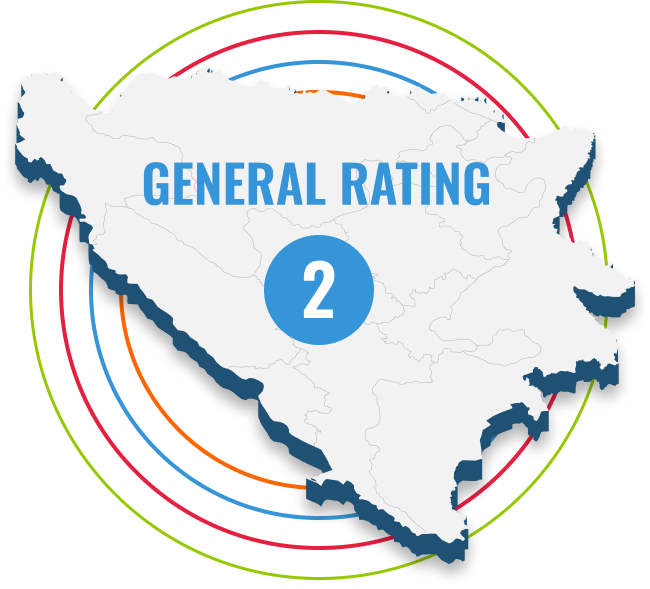
State capture in B&H has systemic and multidimensional elements, through rooted political clientelism as a key form of manifestation. Political parties – the key generator of state capture, exercise effective control over the distribution of public resources, thus relativizing the functionality of the key mechanism of political responsibility – the electoral process.
The decision-making process is essentially non-inclusive, without a foundation in a strategic approach and to a very limited extent supported by indicators, and often represents a mere formal procedural framework for the transmission of particular interests of political parties into formal decisions.
The dominance of political parties is strongly manifested through the instrumentalization and dysfunctionality of the accountability system, making it impossible to prevent, detect and sanction abuses, making impunity widespread.
Overall, B&H functions as a hybrid regime in which democratic forms and mechanisms of responsibility are formally established, but the functioning of all four dimensions – the democratic process, the decision-making process, the system of responsibility and the distribution of public resources – is strongly conditioned by particular interests.